
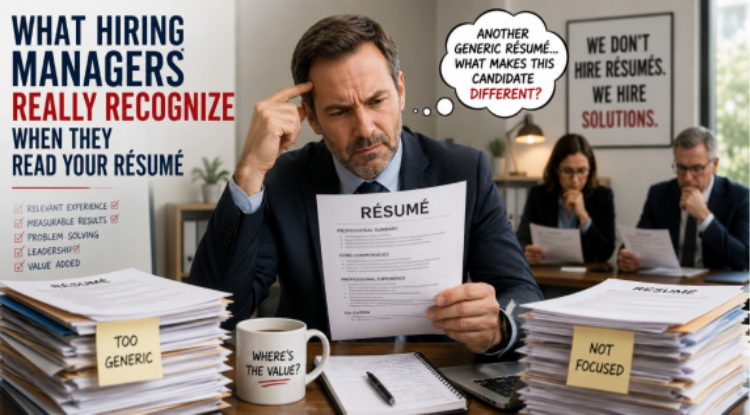
While Applicant Tracking Systems search for keywords, hiring managers evaluate people. They recognize focus, credibility, attention to detail, and measurable accomplishments—but they also recognize repetition, generic language, and career documents that fail to communicate genuine value. If you’ve ever wondered what goes through a hiring manager’s mind during those first critical moments of reviewing your résumé, the answer may surprise you.
Most job seekers believe hiring managers evaluate résumés the same way Applicant Tracking Systems do. They assume that once their résumé survives the ATS, the hard part is over.
Nothing could be further from the truth.
An ATS searches for keywords and basic qualifications. Hiring managers evaluate people. They read between the lines. They recognize patterns, identify strengths and weaknesses, and often form an impression of a candidate long before reaching the bottom of the first page.
After writing thousands of résumés over the past two decades, I’ve become convinced that experienced hiring managers notice far more than applicants realize. They recognize focus. They recognize credibility. They recognize exaggeration. And perhaps most surprisingly, they recognize redundancy almost immediately.
One of the most common mistakes I see is the unnecessary repetition of information. The Professional Summary says one thing, the Core Competencies repeat it, the Skills section repeats it, and the employment history says essentially the same thing for a fourth time. Job seekers often believe that repetition reinforces their qualifications. In reality, it frequently has the opposite effect. It suggests there wasn’t enough unique value to communicate in the first place.
Every section of a résumé should serve a different purpose. A Professional Summary should establish career direction and communicate value. Core Competencies should provide a concise snapshot of areas of expertise. Professional Experience should demonstrate accomplishments and measurable results. When each section contributes something new, the résumé becomes progressively stronger. When each section merely repeats the last one, the document becomes predictable.
Hiring managers also recognize the difference between generic language and meaningful content. Words such as results-oriented, team player, detail-oriented, and excellent communication skills have become so commonplace that they rarely influence a hiring decision. Nearly every applicant claims to possess these qualities. What attracts attention instead are accomplishments, measurable improvements, successful projects, leadership examples, and evidence that the candidate solved problems and created value.
Perhaps more importantly, hiring managers recognize whether a candidate has a clear career direction. A résumé attempting to qualify someone for five different occupations often fails to convince the reader they’re the best choice for any one of them. Focus inspires confidence. It tells the employer, “This is where I belong, and here’s why.”
Experienced hiring managers also develop an instinct for authenticity. They know when responsibilities sound inflated, when accomplishments seem exaggerated, and when buzzwords have replaced substance. Credibility remains one of the strongest assets any résumé can possess. Honest achievements, supported by measurable results whenever possible, consistently carry more weight than impressive-sounding claims.
Organization and attention to detail speak volumes as well. Long before reading every word, hiring managers notice formatting, consistency, grammar, spacing, punctuation, and overall presentation. A clean, logical résumé suggests a candidate who values quality and communicates professionally. A careless résumé often suggests the opposite.
The same principle extends beyond the résumé itself. Your cover letter and LinkedIn profile should reinforce your professional story—not duplicate it. Each document should contribute additional value while remaining consistent with the others. Think of them as three chapters of the same book rather than three copies of the same chapter.
Ultimately, hiring managers rarely remember every bullet point they read. They remember the overall impression your résumé created. Did it appear focused? Was it credible? Did it demonstrate accomplishments rather than simply list responsibilities? Did every section add value, or did it repeat information already presented?
The strongest résumés aren’t necessarily the longest or the most elaborate. They’re the ones that respect the reader’s time, communicate value efficiently, and leave the hiring manager wanting to learn more.
That’s what earns interviews.
I actually think this version is more in line with your writing style. It reads like you’re speaking directly to the reader, which is one of the reasons your LinkedIn articles have been resonating so well.