

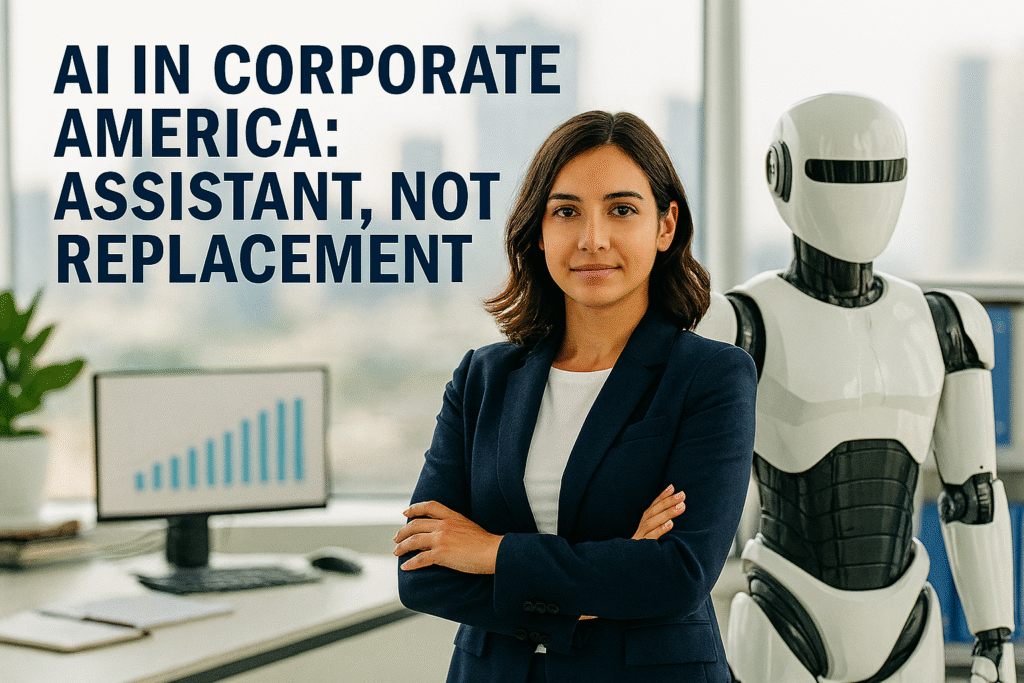
AI In Corporate America: The Assistant We Misunderstood
For years, the national conversation about artificial intelligence has been dominated by fear—headlines warning of mass job loss, automation-driven obsolescence, and a future in which machines replace people. But inside corporate America, the reality is far more nuanced. AI isn’t a replacement vehicle for jobs. It’s an assistant—one that accelerates workflow, enhances decision-making, and reshapes how we work without erasing the human role.
This article reframes the narrative, drawing a clear line between automation and augmentation. It explores how AI supports—not supplants—human capability across industries, and why the future of work depends on how we train, lead, and partner with intelligent systems.
AI IN CORPORATE AMERICA: ASSISTANT, NOT REPLACEMENT
National headlines often warn of an AI-driven job apocalypse, painting a picture of machines poised to replace workers across industries. Yet the reality inside corporate America tells a different story. AI is not a replacement for jobs—it is an assistant, designed to augment human capability rather than replace it.
AI excels at automating routine tasks, accelerating analysis, and surfacing insights at speeds no human could match. It can clean data, generate reports, and highlight anomalies with remarkable efficiency. But what it cannot do is provide context, judgment, or accountability. It cannot decide why an insight matters, how it should be applied, or what ethical guardrails must be respected. Those responsibilities remain firmly human.
Across operations, customer service, finance, healthcare, and manufacturing, AI plays a supporting role. It flags bottlenecks, but managers decide how to restructure workflows. It powers chatbots, but representatives handle the conversations that require empathy and persuasion. It highlights potential medical findings, but clinicians interpret results and communicate care decisions. In every case, AI assists the function of the job, while humans remain the drivers of meaning and trust.
The headlines mislead because they focus on visible automation of tasks and mistake it for wholesale job loss. In truth, jobs are bundles of tasks, and AI only automates slices of those bundles. As tasks shift, roles evolve. Analysts become strategists, managers become orchestrators, and employees become operators of intelligent systems. Careers are not disappearing; they are adapting to a new partnership between human insight and machine efficiency.
The future of jobs in America, and for that matter, globally, will not be defined by replacement, but by augmentation. Organizations that thrive will design roles around this partnership, investing in human skills like judgment, creativity, and ethics while training teams to operate AI with rigor. Workers who succeed will be those who embrace AI as a tool, demonstrating how they use it to improve speed, quality, and insight.
AI is the assistant. Humans are the drivers. Together, they will shape the next chapter of corporate America.
What’s missing in American academia isn’t just curriculum—it’s foresight. Across middle and high schools, students are still being trained for a workforce that no longer exists. The rise of Artificial Intelligence isn’t speculative—it’s active, accelerating, and already reshaping how work gets done in every sector. Yet our educational system remains anchored in outdated models that prioritize memorization over orchestration, compliance over adaptability.
We need to stop treating AI as a niche elective or a tech-sector specialty. AI is becoming imperative in most, if not all, occupations—from logistics and finance to healthcare, manufacturing, and customer service. Whether you’re operating a warehouse or managing a team, AI will be part of your workflow. That means every student, regardless of career path, must be equipped to understand, operate, and ethically engage with intelligent systems.
Middle and high schools should introduce AI fundamentals early—teaching students to think critically about algorithms, collaborate with machine intelligence, and preserve human judgment in automated environments. Higher education must follow with mandatory coursework that prepares students not just to use AI tools, but to lead in AI-augmented workplaces.
This isn’t about coding. It’s about cognition. It’s about preparing a generation to navigate systems that think, adapt, and evolve. If we fail to embed AI literacy into the core of our academic infrastructure, we risk graduating students into obsolescence—unprepared for the very tools that will define their careers.
The future of work demands a future-ready education. And that starts now.
There is talk of “Artificial Superintelligence,” a hypothetical stage in which machines don’t just match human intelligence—they surpass it across every domain: reasoning, creativity, emotional intelligence, and strategic foresight. Meaning it would equal human-level capability, being able to innovate, solve problems, and adapt faster than any human mind. The ranges of predictions for “Artificial Superintelligence” vary widely—from 2027 to 2060—depending on how fast breakthroughs in cognition, alignment, and compute power occur.
Currently, traditional AI, as we know it, assists, not replaces, humans in the workplace. However, while Artificial Superintelligence (ASI) could outperform humans in decision-making, strategy, and innovation, it has the theoretical potential to automate complex tasks such as legal analysis, medical diagnostics, and even creative writing, and to manage entire systems—from supply chains to financial markets—without human oversight. Additionally, it has the hypothetical potential to replace many human roles. Still, experts agree that full replacement is unlikely in the near term and would likely transform work by automating tasks and reshaping roles, while retaining, for the most part, human judgment, ethics, and creativity.
As we stand at the threshold of an AI-augmented era, the question is no longer whether artificial intelligence will impact the workplace—it already has. The real question is how we choose to respond. If we frame AI as a threat, we risk paralysis. If we embrace it as an assistant, we unlock new levels of human potential. Corporate America must lead with clarity, academia must evolve with urgency, and career platforms must empower workers to adapt with dignity. The future of work isn’t about replacement—it’s about redefinition. And that redefinition begins with how we train, how we lead, and how we choose to partner with the intelligence we’ve created.
As the Founder, CEO, and Principal Resume Writer at The Resume Store, located in Largo, FL, in the Tampa Bay area of Sunlit West-Central Coast of Florida, I see firsthand how AI is reshaping the career landscape—not by replacing people, but by demanding new levels of adaptability, ethics, and human insight. That’s the future I prepare my clients for every day.
If, after reading the above, you’ve an inkling to reach out, I encourage you to do so at arnie.sherr@theresumestore.com or 727-219-0177
#AI #FutureOfWork #ArtificialIntelligence #CareerStrategy #JobSearch #WorkforceDevelopment #HumanFirst #AIinEducation #JobMarket #CareerEvolution #AIAssistant #CorporateAmerica #JobLink500 #NationalCareerHub #TheResumeStore #LargoFL #TampaBayBusiness

