One of the most common misconceptions among job seekers is the belief that a résumé or cover letter is intended to get them hired. In reality, neither document has ever had that responsibility. Résumés and cover letters are marketing tools—not sales tools.
Their purpose is not to close the deal. Their purpose is to generate interest, communicate value, establish relevance, and persuade a recruiter or hiring manager to take the next step: initiating an interview. The actual hiring decision occurs much later, after interviews, evaluations, assessments, reference checks, and internal discussions have taken place.
When viewed through this lens, the objective of a professionally written résumé becomes much clearer. Success is not measured by whether the document gets someone hired. Success is measured by whether it effectively positions the candidate, demonstrates alignment with the employer’s requirements, and earns that critically important first interview opportunity.
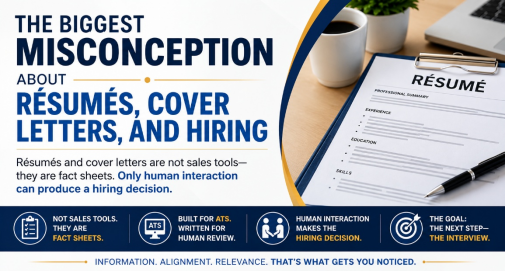
One of the biggest misconceptions in today’s job-search industry is the belief that résumés and cover letters are sales tools designed to get people hired. They are not.
A résumé does not hire anyone. A cover letter does not hire anyone. Only human interaction can produce a hiring decision.
This distinction is important because it changes how job seekers should view both documents.
Many résumé writers describe a résumé as a marketing piece or a personal sales brochure. I disagree. A résumé is a fact sheet. Its purpose is to present factual information about a candidate’s background, experience, accomplishments, skills, education, and qualifications in a manner that allows both Applicant Tracking Systems (ATS) and hiring managers to efficiently evaluate relevance and fit.
Think about shopping for a computer at Best Buy. Attached to the computer is a specification tag listing the processor, memory, storage capacity, graphics capability, and other features. That tag does not sell the computer. It provides factual information that allows a shopper to determine whether the product meets their needs.
A résumé serves a similar purpose. It presents information in a structured manner that enables employers to determine whether a candidate warrants further evaluation.
This is where the professional résumé writer creates value. The résumé writer’s responsibility is not to manufacture personality, create fictional branding, or persuade employers to make hiring decisions. The responsibility is to extract relevant information, organize it logically, align it with the employer’s requirements, satisfy ATS criteria, and present it in a manner that captures the attention of hiring managers evaluating candidates for a particular role.
Unlike many résumé writers, I remain exceptionally technologically adept at age 83. In fact, unlike many local competitors, I have fully embraced Artificial Intelligence as a powerful enhancement tool—not to write my clients’ résumés, but to refine wording, strengthen ATS (Applicant Tracking System) alignment, improve keyword integration, identify opportunities for greater relevance, and help ensure content resonates effectively with recruiters and hiring managers, thereby increasing the likelihood of earning that all-important first interview phone call.
By combining more than 17 years of résumé-writing expertise with today’s most advanced technology, I am able to produce highly targeted, strategically optimized documents that frequently achieve ATS compatibility scores exceeding 95% and are designed to perform effectively in both Applicant Tracking Systems and human review. The result has been a level of effectiveness that has helped my clients sustain The Resume Store’s longstanding 85% interview success rate.
In simple terms, the résumé writer helps ensure that the information most relevant to the employer is the information most readily recognized during the evaluation process. By doing so, the writer increases the probability that the candidate’s qualifications will resonate with the individuals (hiring managers) reviewing the résumé and stimulate sufficient interest to justify further consideration.
Likewise, a cover letter is not a sales letter. It is an introduction. It communicates the candidate’s intent, identifies the position or category of positions being pursued, and provides context for the accompanying résumé. Its purpose is to introduce the candidate and direct attention to the résumé, not to secure employment.
The real objective of both documents is much simpler than many people realize: to encourage the next step in the process, which is hopefully a phone interview.
Contrary to popular belief, hiring managers are not always searching for the “best” candidate. They are evaluating information and attempting to determine which candidates appear most likely to succeed within their organization. They assess qualifications, experience, responsibility, scope, relevance, and potential fit. Most importantly, they evaluate risk.
A poor hiring decision can be costly. Training expenses, lost productivity, customer impact, team disruption, turnover, and managerial accountability all contribute to the risk associated with hiring. The higher the position, the greater the potential consequences of making the wrong decision.
As a result, hiring managers often spend as much time trying to avoid mistakes as trying to identify top talent.
The process itself is rarely as simple as many job seekers imagine. Some hiring decisions are made by individual managers. Others involve supervisors, department heads, human resources professionals, executives, committees, or peer interview teams. In large organizations, universities, healthcare systems, government agencies, and Fortune 500 companies, hiring decisions frequently involve multiple stakeholders and several layers of approval.
This explains why hiring timelines often extend well beyond what applicants expect. Six weeks is common. Three months is not unusual. In some organizations, six months can be entirely realistic.
The résumé’s role is to present accurate, relevant, and credible information. The cover letter’s role is to introduce the candidate and communicate intent. The interview’s role is to evaluate communication skills, judgment, professionalism, interpersonal effectiveness, and organizational fit.
That is where hiring decisions are made.
Ironically, one of the greatest benefits of a professionally developed résumé has little to do with the employer. Many clients become excited when they see their completed résumé because, for the first time, they see their careers accurately represented. The document does not create value; it reveals value that already exists. It clarifies experience, highlights accomplishments, and helps individuals better understand their own professional contributions.
That confidence can be beneficial. However, the résumé itself remains what it was always intended to be: a factual representation of a candidate’s qualifications.
Hiring occurs when people interact.
The résumé and cover letter simply help make that interaction possible.
If you would like additional information about professional résumé services, please feel free to contact me at info@theresumestore.com or visit The Resume Store for pricing, package options, and other helpful information. I am always available to discuss your career goals and determine how I can help turn them into a reality.
CLICK HERE to view my 162 and growing 5-star Google reviews
For comprehensive career-development and job-search guidance, my Get A Job Manual provides practical strategies for navigating today’s highly competitive employment market. Drawing upon real-world hiring, recruiting, sales, management, and résumé-writing experience, it teaches you how to market yourself effectively, excel during interviews, answer difficult questions, negotiate compensation, and position yourself as the ideal solution to an employer’s needs.
📘 Interested in my recently republished book, The Get-A-Job Manual? It’s available at: 🔹 Amazon | BarnesandNoble 🔹 and most other major online booksellers.