
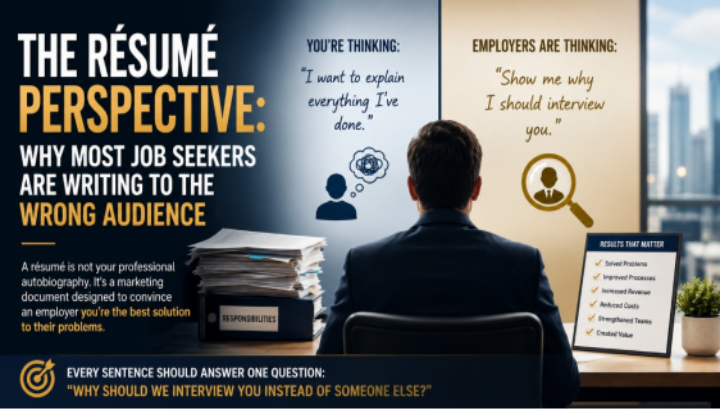
Most job seekers believe a résumé should tell their career story. That’s understandable—but it’s also one of the biggest reasons qualified candidates fail to secure interviews. In this article, I explain why successful résumés are written from the employer’s perspective, not the applicant’s, and how that single shift in thinking can dramatically improve your chances of being invited to an interview.
If you’re wondering where what you just wrote went, you’re not alone—and there’s a reason it might feel like it’s missing.
Most résumés fall short before they’re even finished—and it’s not because of formatting, keywords, or length. It’s because they’re written like autobiographies.
I see it all the time. Candidates sit down to write their résumé and instinctively start telling their story from beginning to end. They list every role, every responsibility, every task, as if the goal is to document their entire career. It feels logical. It feels thorough. It feels complete.
But it’s also the mistake that keeps them from getting interviews.
A résumé isn’t a personal history. It’s not a timeline. And it’s definitely not a place to prove how busy you’ve been.
And here’s where I’m going to be direct—you might think you already know how to write one because you’ve read articles, watched videos, or followed templates. But knowing how to list your experience is not the same as knowing how to position it in a way that resonates with hiring managers.
That’s a skill. And it’s one I’ve spent years developing—crafting language that speaks directly to what hiring managers and HR professionals are actually looking for. Not what candidates think sounds good, but what compels decision-makers to take action.
Once you shift your perspective and treat your résumé like a business document designed to communicate value, everything changes—and it’s exactly the kind of shift I break down throughout my book, The Get A Job Manual.
Most job seekers approach their résumé from their own point of view, focused on telling their story from beginning to end. That instinct makes sense—but it’s also why so many résumés fail to gain traction. I don’t write résumés from the candidate’s perspective. I write them from the employer’s.
When clients explain their background, they often walk through every role, responsibility, and task, assuming the résumé needs to capture their entire professional journey.
It doesn’t.
I’m not writing a biography. I’m building a business document designed to answer one question: why should this person be interviewed?
Instead of documenting everything someone has done, I focus on what an employer needs to see. Hiring managers aren’t reviewing résumés out of curiosity—they’re trying to solve a problem. They’re asking,
“Can this person help my organization succeed?”
That’s why each section serves a specific purpose. Job titles position the candidate. Qualification summaries establish relevance. Career highlights demonstrate impact. Achievements show results—improvements, efficiencies, revenue growth, cost savings, leadership, customer satisfaction, compliance, innovation, or operational success.
For example:
Before (task-based): Managed customer service calls and responded to inquiries.
After (impact-based): Resolved 50+ customer inquiries daily while improving satisfaction scores by 18% through faster response times and issue resolution.
Before (task-based): Responsible for overseeing team operations and scheduling.
After (impact-based): Led a team of 12 employees, optimizing scheduling processes to reduce overtime costs by 22% while maintaining full operational coverage.
Two candidates with similar backgrounds can receive very different responses. One résumé explains what the person did. The other shows why it mattered.
Employers aren’t buying experience. They’re investing in future performance.
That’s why I avoid long lists of routine responsibilities unless they serve a purpose. Many people have managed projects, answered phones, supervised teams, or supported customers. Those details don’t differentiate a candidate—they only describe the job.
What matters is what the candidate accomplished within those responsibilities.
Every résumé should reflect that idea. Employers hire people because they believe those individuals will solve problems, improve processes, strengthen teams, increase revenue, reduce costs, enhance customer satisfaction, minimize risk, or contribute in meaningful ways.
That’s the perspective you need to adopt.
I also don’t aim for perfection. Hiring managers aren’t expecting it. What they’re looking for is confidence—confidence that the person they’re considering can step in, adapt, and contribute without excessive ramp-up time.
The résumé has to create that confidence before the interview ever happens.
Too many candidates assume they’ll explain their value once they get in the room. But if the résumé doesn’t make that case clearly, they never get the chance.
When writing, evaluate every line through the employer’s lens. Does it communicate value? Does it differentiate the candidate? Does it show measurable impact? Would a hiring manager immediately understand why this person is worth interviewing?
Because employers aren’t looking for the most detailed résumé. They’re looking for the most convincing one.
When reviewing a finished résumé, read it as a hiring manager who has never met the candidate and has thirty seconds to decide.
If it answers the question, “Why should I interview this candidate?”—then it’s doing exactly what it’s supposed to do.
And remember: the résumé is not what gets you hired. Its purpose is to put you in front of hiring managers. From there, the responsibility shifts to you. You have to communicate your value, answer questions with confidence, and demonstrate why you are the right fit. The document opens the door, but your preparation and performance in the interview determine whether you walk through it. If you’re not confident in your ability to do that yet, that’s exactly why I recommend working through The Get A Job Manual—it’s designed to prepare you for every stage of the process, including the interview itself.
If reading this article has prompted you to reach out to me, I would be pleased to discuss your career goals and how my 17 years of résumé writing and career coaching experience may help position you for your next professional opportunity. Please do so at info@theresumestore.com or call me at 727-219-0177
To learn more about my services and how I help professionals position themselves for career advancement, visit: www.TheResumeStore.com